
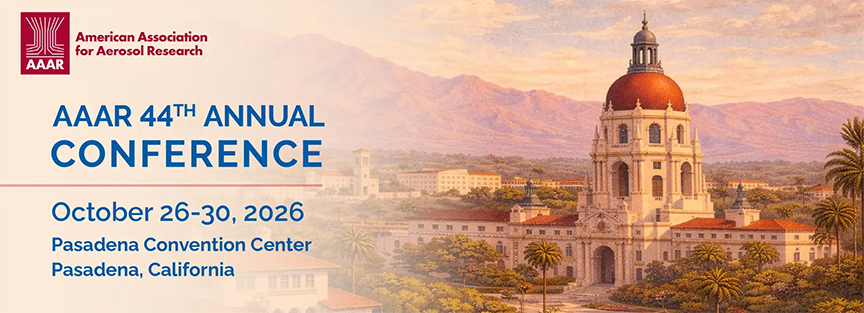
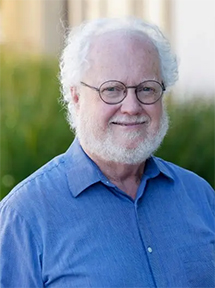
Dr. Richard Flagan, H. Corcoran Professor of Chemical Engineering and Environmental Science and Engineering at Caltech, has graciously accepted AEESP's invitation to provide a lecture at the 44th Annual Conference of the American Association for Aerosol Research (AAAR) Conference at the Pasadena Convention Center in Pasadena, CA.
Dr. Flagan's presentation, entitled "The Great Smog Caper" is scheduled for Tuesday, October 27 during the first Plenary Session.
AEESP thanks Dr. Flagan for representing the association at this great annual event, and we thank AAAR for hosting this annual AEESP lecture.
For more information about the 44th AAAR Conference and to register, visit their website and be sure to attend Dr. Flagan's session on Tuesday!
Lecture Abstract:
The 2026 AAAR conference has come to Pasadena where the science of photochemical smog started. Leo Cabrillo labeled southern California’s San Pedro harbor the Bay of the Smokes in the 1530’s. Four centuries later, Arie Haagen-Smit, a Dutch biochemist, joined the Caltech faculty at a time the local mountains disappeared in the haze with increasing frequency. When the plants he was studying began to suffer, he sampled the air to find the culprit and, after finding organic nitrates in the brew, deduced the role of nitrogen oxides in automobile emissions in producing ozone, and volatile organic compounds in producing the dense brown haze in the Los Angeles smog. Chemists at the University of California at Riverside, farther downwind from LA, explored the chemistry behind the smog. Young William E. Wilson working at the National Air Pollution Control Administration convinced key researchers to study the haze, leading to the 1969 “Great Smog Caper” in which Ken Whitby, Sheldon Friedlander, Bob Charlson, George Hidy, Peter Mueller, Dale Lundgren, and Benjamin Liu, brought their instruments and students to Caltech in Pasadena to measure the smog aerosol. Primitive by today’s standards, their measurements yielded critical new insights into atmospheric aerosols. Particle size distribution measurements spanning from 6µm to 3nm revealed several peaks in the size distribution that pointed to diverse sources and mechanisms in the aerosol dynamics – stimulating fundamental experimental and theoretical studies that form the foundation of modern aerosol science and development of early models of photochemical smog formation. The Great Smog Caper is a cornerstone of aerosol science and the air quality engineering that followed. This lecture will provide a glimpse into the origins of our science, and some of the challenges that the pioneering participants into the Great Smog Caper faced that we, fortunately, no longer have before us.
About Dr. Flagan:
Dr. Rick Flagan in the Irma and Ross McCollum/William H. Corcoran Professor of Chemical Engineering and Environmental Science and Engineering at Caltech. He received his BS in Mechanical Engineering from the University of Michigan, and his SM and PhD, also in Mechanical Engineering from MIT, with a thesis on the formation of gaseous pollutants in combustion. Upon joining the Caltech faculty, he shifted his focus to aerosols. He is a leader in the broad field of aerosol science where his research focuses on atmospheric aerosols and their impacts on climate, air quality, and human health, and on the development of methods for measurement of aerosol particles from many micrometers to 1 nm in size. He has invented numerous instruments and experimental methods for measuring fine airborne particles, including one, the Scanning Mobility Particle Sizer (SMPS), that has become the primary instrument worldwide for the measurement of aerosol particles smaller than 1 µm. His research has contributed substantially to present understanding of smog and the links between fine aerosol particles and clouds. He has served as President of AAAR, and as Program Chair of the 1994 International Aerosol Conference in Los Angeles. Among other awards, Prof. Flagan's contributions to aerosol and atmospheric science have been recognized with election to the National Academy of Engineering (2010) and the Fuchs Award (2006), the highest award in the field of aerosol science.